


ERP vs MRP: What Does Your Manufacturing Business Need?
Key Takeaways:
Choosing between ERP and MRP software is a major decision for manufacturing businesses. Both serve entirely different purposes:
- MRP concerns resource and production planning
- ERP connects manufacturing with business activities
The right choice among them depends entirely on the business’s individual workflows, operational complexity, integration requirements, and growth goals. Both can be connected to create a cohesive digital environment.
Manufacturers evaluating which software to get often end up having the classic ERP vs MRP debate. This debate is likely to end in an impasse, as smart manufacturing needs more than just production planning. The only way it can thrive is when materials, production, inventory, purchasing, finance, and other core operational functions get to interact in a connected environment.
That means spreadsheet-based production planning is already out of the race. It is completely disconnected and is bound to cause the very same problems that businesses are trying to fix.
Coming back to the ERP vs MRP debate, allow us to help businesses still caught in the storm of confusion. This guide from ERPion, smart ERP software widely used by Ontario manufacturing businesses, will break down the differences between the two so organizations can make an informed choice.
What Is MRP?
MRP, or Material Requirements Planning software, is a system that primarily helps manufacturers plan and manage the use of the resources at their disposal for the purposes of production. This software decides which materials need to be used when and in what quantities. It supports production planning by connecting essential aspects of it such as schedule, inventory, and demand.
How Material Requirements Planning Works
MRP gathers information present in production schedules, bills of materials (BOMs), inventory records, and expected demand forecasts and then uses them to calculate exactly how much material is needed for a given production run. Planners can use this software to determine exactly when they need to replenish their existing inventory to keep production moving as planned.
What MRP Helps Manufacturers Manage
Material coordination and manufacturing readiness lie at the core of MRP software. Its major capabilities surround these two activities:
- Material requirement calculations
- Resource tracking
- Purchase and replenishment planning
- Production scheduling assistance
- Material shortage detection
All in all, MRP is a valuable tool for manufacturers as it helps them gain control over their production process and materials without creating strong dependencies on other business systems.
What Is ERP?
ERP or Enterprise Resource Planning software, is a highly integrated digital platform whose core functionality is to connect all critical business functions via shared databases and workflows. ERP brings everything – from production and inventory to purchasing, finance, and sales – under a single operational umbrella. It is a great unifier.
How ERP Connects Business Operations
Built to be a smart piece of technology, ERP software for manufacturing collects and centralizes information from every single relevant department to create consistent and accurate records that serve as a universal source of truth.
There is no need to maintain detailed spreadsheets or disconnected applications when a business has ERP. They can access and gain complete visibility into inventory, finance, sales, purchasing, and other operational activities whenever they need.
What ERP Adds Beyond Manufacturing Planning
Apart from supporting manufacturing planning, ERP also aids:
- Tracking finance and accounting operations
- Managing inventory and purchasing
- Handling sales and order requirements
- Report generation and operational integration
Even as a standalone tool, ERP helps manufacturers make smarter decisions, especially as far as purchasing, order fulfilment, costs, and other essential business functions are concerned.
ERP vs MRP: Key Differences
ERP and MRP should not be considered substitutes for each other. The scope of their function is entirely different. While MRP concerns itself only with material requirements and manufacturing planning, ERP connects these and other essential business activities and fits them into consistent yet flexible workflows. The broad differences between them include:
Scope and Business Functions
As we mentioned before, MRP only concentrates on production-based requirements. ERP’s scope is much broader as it connects all essential business functions, including inventory, finance, reporting, sales, etc.
Production and Material Planning
While both systems support manufacturing planning, they do it differently. MRP can help manufacturers optimize their inventory and production schedules, but ERP can connect planning with operational workflows.
Data and System Integration
MRP is capable of operating independently, unlike ERP, which depends on tool integration to function. That is the only way it can establish a shared database for all essential business functions.
Reporting and Business Visibility
Reports generated by an MRP system only provide inventory and production-related data. Whereas ERP reports provide detailed insight and visibility into the business’ entire operational and financial performance.
Scalability and Business Growth
Both can evolve alongside a business if they feature a scalable architecture. However, ERP features smart integration capabilities, which give it an edge when it comes to incorporating expanding business operations.
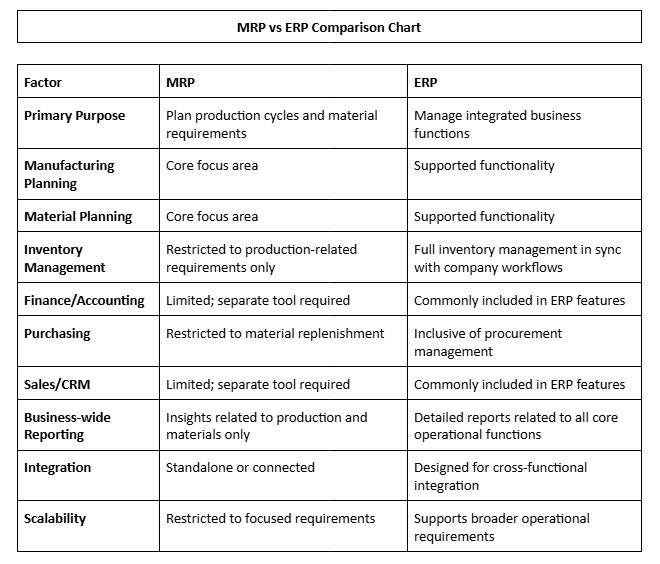
A quick scan of the table given above may make MRP seem redundant, but it has its own space in the digital framework of a manufacturing company. However, ERP is absolutely non-negotiable, thanks to its ability to tackle every essential operational requirement, including material and production planning.
ERP vs MRP Comparison at a Glance
For manufacturers still on the fence about which system to opt for, the following comparison chart is a quick way to understand which system matches their business’ immediate priorities.
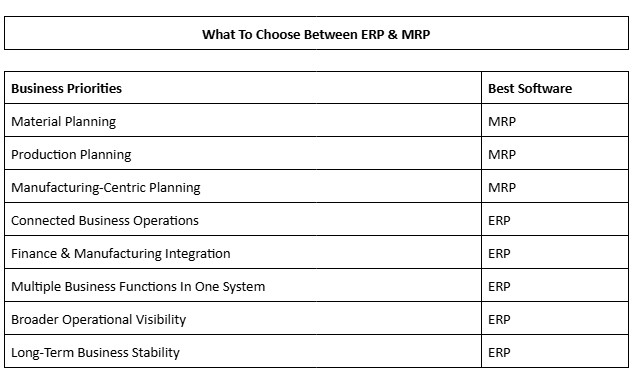
The decision to choose one over the other should also account for existing software and the integration goals of a company so that future operational changes can be accounted for.
In any case, it is important for manufacturers to know that MRP capabilities can exist within an ERP system. Most manufacturers do not actually need to choose two entirely separate platforms to run daily operations. They only need to determine if standalone tools are enough to suit their requirements, or if integrated software provides better value.
When Is MRP the Better Choice?
As is evident, MRP is not without its merits, and might be the better choice for businesses under specific circumstances. As a standalone system, it is easier to implement and provides necessary functionality that manufacturing companies need.
Manufacturers With Focused Planning Requirements
Manufacturers with highly specific material planning requirements need a system that supports accurate calculations and production schedules. MRP is the most suitable tool for them as it offers targeted planning capabilities.
Businesses With Limited Operational Complexity
Relatively straightforward manufacturing workflows may not require deeper integrations, which means MRP is a good fit here.
Situations Where Existing Business Systems Already Work
If companies already have a system in place for finance, sales, and purchasing, they might get by implementing just an MRP platform. However, it must meet their integration needs so it offers reliable information without leading to manual workarounds.
When Should Manufacturers Choose ERP?
Manufacturing ERP software is a highly relevant option for businesses that thrive when every single one of their processes is connected with the other. The integration it offers is highly useful in giving decision-makers a complete view of current operations.
Businesses Managing Multiple Connected Functions
Manual maintenance of separate records and transfer of information can cost departments a lot of time. ERP creates shared data and connected workflows, preventing silos and optimizing operations.
Manufacturers Experiencing Operational Growth
More orders, products, locations, etc., can be very complex to manage with standalone systems. ERP’s integration and configurable workflows improve visibility even as operations expand.
Companies Replacing Disconnected Systems and Spreadsheets
Reconciling major order, inventory, or finance-related updates manually is bound to lead to mistakes. The kind of connected manufacturing environment modular ERP brings improves data consistency while preventing silos.
How to Decide Between ERP and MRP
Anchoring the decision to pick one between MRP and ERP in real operational requirements leads to the best outcome. Manufacturers must make sure they compare both options based on the value each offers rather than their features alone.
Step 1: Assess Your Manufacturing Complexity
Evaluate production stages, products, orders, and capacity constraints to understand if coordinating different manufacturing processes is easy or tough. MRP deals with focused requirements better, while integrated functions are the forte of ERP.
Step 2: Identify the Functions You Need to Connect
If production, inventory, purchasing, sales, finance, etc. need to be a part of a connected digital environment, ERP is a more sensible choice.
Step 3: Evaluate Your Current Systems
Existing applications and spreadsheets are seldom enough to sustain expanding operations. Duplications, delays, and inconsistencies must be resolved appropriately. That said, manufacturers should know that MRP can only solve isolated planning issues. Meanwhile, ERP fixes wider fragmentation issues.
Step 4: Consider Integration Requirements
If integration is a priority, ERP should be the default choice.
Step 5: Plan for Business Growth
Scalability is another area that modular ERP systems are better equipped to tackle. They enable manufacturers to expand system functionality as and when their business grows.
Step 6: Compare Total Value and Implementation Requirements
Costs, implementation effort, training, and expected benefits are different for both MRP and ERP. Businesses must choose the system that solves their most critical operational issues in the most sustainable manner.
Common Mistakes When Choosing Between ERP and MRP
Selecting software without fully understanding its pros and cons can lead to persistent data, planning, and integration problems. Businesses must make sure they avoid the following expensive mistakes:
Choosing Based Only on Current Requirements
Business expansion and future integration needs must be factored into software selection.
Ignoring Integration and Data Flow
Disconnected systems preserve manual interventions, which software is designed to eliminate.
Comparing Software Features Without Business Processes
Instead of counting features, manufacturers must evaluate how each system fits into their specific workflows and whether it delivers measurable value.
Software selection checklist to choose the right one:
- Assess current and future needs
- Document existing workflows
- Identify data gaps and disconnected systems
- Review integration requirements
- Factor in sustainability and scalability
- Understand implementation procedure
- Compare real value instead of superficial features
Avoid selecting software based solely on its price. It does not guarantee cost savings and may lead to additional expenses down the line.
Conclusion
Only the scope of a business’ manufacturing requirements can ultimately determine whether they need MRP or ERP. We generally recommend businesses get both primarily because they serve entirely different functions. With ERP, manufacturers can create connected workflows. Meanwhile, MRP lets them optimize production and material planning. Neither wins nor loses. They are both simply essential.
If you are looking for the best ERP in the biz, though, ERPion is the right choice for you. This modular system can be configured and customized as you please while fitting into your budget. Contact us to learn more about this zero licensing fee platform.
FAQs
What is the difference between ERP and MRP?
The primary difference between ERP and MRP is that the latter focuses on material requirements and production planning only, while the former is responsible for syncing manufacturing processes with broader business functions for greater visibility and coordination.
Is ERP outdated?
Absolutely not. Modern ERP is an advanced version of itself, and it supports a variety of smart tech, including cloud-based architecture, automation, analytics, and improved integration capabilities to keep pace with evolving business requirements.
What are the four ERP types?
The four major types of ERP include on-premises, cloud, hybrid, and two-tier ERP. Manufacturers have the full freedom to choose the model that best meets their operational requirements.
What is replacing ERP?
No universal alternative can replace ERP. However, companies demand more from their systems now than they used to. Vendors are stepping up their game by using technologies such as automation, cloud-based frameworks, and AI to expand ERP’s capabilities.
What are the disadvantages of ERP?
ERP’s cons can be easily managed with the help of modular software. Common challenges include high implementation costs, data migration issues, training requirements, process changes, and complex configurations.